
How Advanced IVF Laboratory Technology Supports Fertility Treatment Outcomes in Goa
Does IVF laboratory technology affect IVF success rates?
Yes. Clinical guidelines from the European Society of Human Reproduction and Embryology (ESHRE) emphasise that laboratory quality, embryo culture conditions, and sperm selection techniques play an important role in IVF outcomes. Advanced embryology technologies such as Intracytoplasmic Sperm Injection (ICSI), Microfluidic Sperm Selection, and Laser-Assisted Hatching (LAH) may help improve fertilisation and embryo development in selected fertility cases.
Understanding the Role of the IVF Laboratory
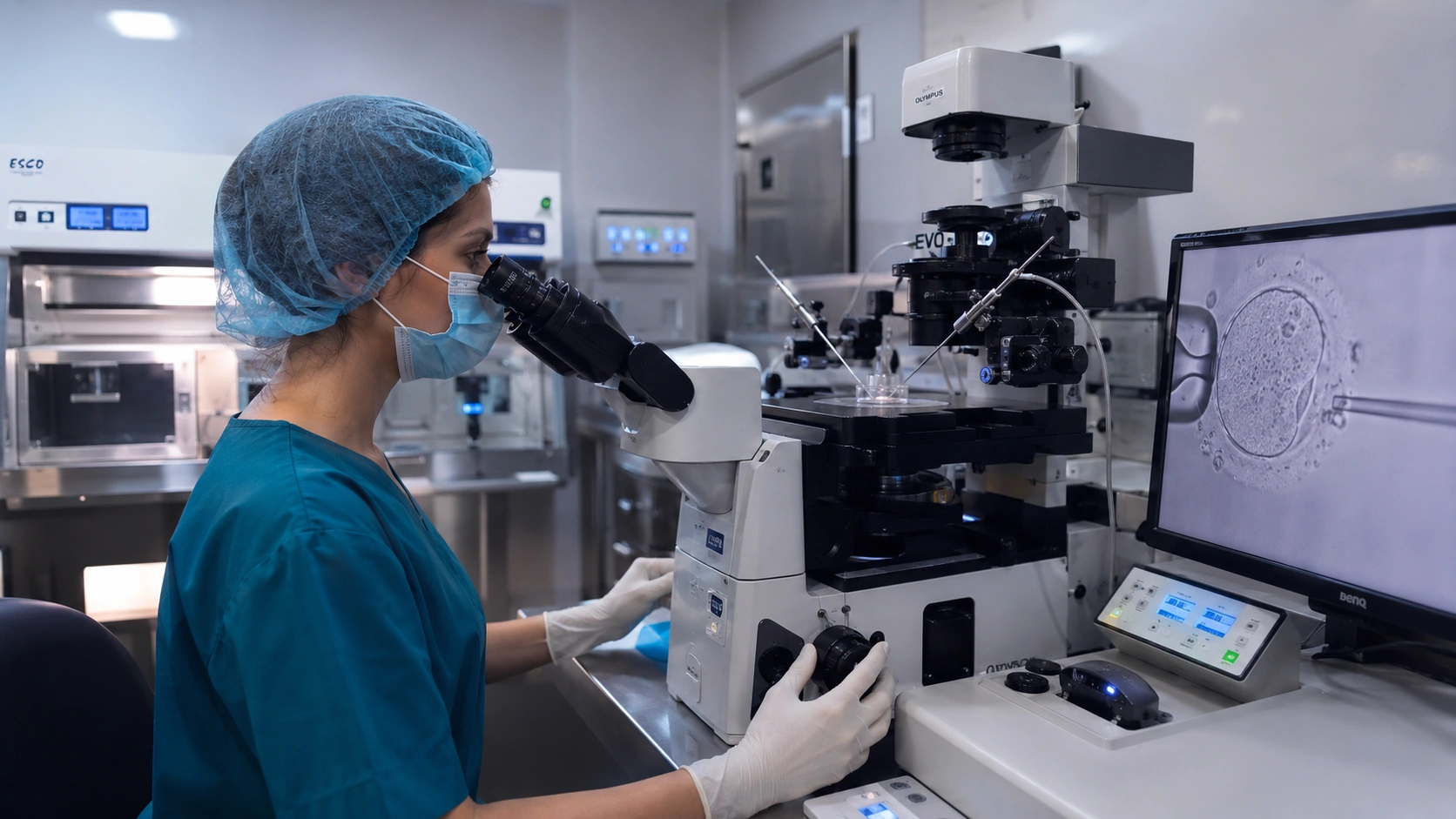
An IVF laboratory is a highly controlled medical environment where fertilization and early embryo development occur outside the body.
Laboratory quality can influence:
- Fertilization rates
- Embryo quality
- Embryo development
- Implantation potential
Modern fertility laboratories use specialized equipment to maintain stable:
- temperature,
- humidity,
- gas concentration,
- and embryo culture conditions.
According to ESHRE laboratory guidelines, maintaining strict embryology standards is essential for optimizing assisted reproductive treatment outcomes.
Intracytoplasmic Sperm Injection (ICSI)
What Is ICSI?
Intracytoplasmic Sperm Injection (ICSI) is an advanced IVF procedure in which a single sperm is carefully injected directly into a mature egg under microscopic guidance.
Unlike standard IVF, where fertilization occurs naturally within a laboratory dish, ICSI is designed to assist fertilization when sperm function is impaired.
When Is ICSI Recommended?
According to the American Society for Reproductive Medicine (ASRM), ICSI is commonly recommended for:
- Low sperm count (oligozoospermia)
- Reduced sperm motility (asthenozoospermia)
- Abnormal sperm morphology
- Previous fertilization failure
- Surgical sperm retrieval cases
At IVF Angels Goa, sperm selection is performed using advanced embryology microscopy systems to identify morphologically suitable sperm for fertilization.
Microfluidic Sperm Selection
Traditional sperm preparation techniques often involve centrifugation, which may increase oxidative stress in some sperm samples.
What Is Microfluidic Sperm Selection?
Microfluidic technology uses specialized microscopic channels designed to mimic aspects of the natural female reproductive pathway. Motile sperm with better functional characteristics are able to migrate through these channels for selection.
Potential Advantages
Emerging studies published in reproductive medicine journals suggest that microfluidic sperm selection may:
- reduce sperm DNA fragmentation,
- improve sperm quality selection,
- and support better embryo development in selected patients.
This technology may be considered in:
- recurrent IVF failure,
- high DNA Fragmentation Index (DFI),
- recurrent miscarriage,
- or severe male factor infertility.
Laser-Assisted Hatching (LAH)
For implantation to occur, an embryo must naturally hatch from its outer layer, known as the zona pellucida.
In certain patients, this outer layer may become relatively thicker or less elastic.
What Is Laser-Assisted Hatching?
Laser-Assisted Hatching (LAH) uses a precision medical laser to create a microscopic opening in the zona pellucida before embryo transfer.
When Might LAH Be Recommended?
LAH may be considered in selected situations such as:
- Advanced maternal age (AMA)
- Recurrent implantation failure
- Frozen embryo transfer cycles
- Embryos with thicker zona pellucida
The decision to use LAH is individualized based on embryology assessment and clinical history.
Optimizing Both Embryo Quality and Uterine Health
Successful implantation depends on both embryo quality and uterine receptivity.
In addition to embryology support, fertility evaluation may include assessment of:
- endometrial health,
- uterine cavity abnormalities,
- fibroids,
- polyps,
- adhesions,
- and endometriosis.
Patients with structural uterine conditions may require minimally invasive evaluation or treatment before embryo transfer.
Learn more about:
<a href=”/advanced-laparoscopy-fertility-goa/” target=”_blank”>Advanced Laparoscopic Procedures for Fertility-Related Uterine Conditions</a>
Frequently Asked Questions About Advanced IVF Technologies
Does ICSI increase the risk of birth defects?
According to ASRM data, children conceived through ICSI may have a slightly higher observed risk of certain birth defects compared to natural conception. However, much of this risk is believed to be associated with underlying parental infertility factors rather than the ICSI procedure itself. Proper counseling and individualized clinical evaluation are important.
Is Microfluidic Sperm Selection necessary for all IVF patients?
No. Microfluidic sperm selection is generally reserved for selected fertility cases, particularly where sperm DNA fragmentation or recurrent IVF failure is suspected.
Why do some fertility centres invest in advanced embryology technologies?
Advanced embryology systems allow fertility specialists and embryologists to individualize laboratory approaches based on a patient’s fertility diagnosis and treatment history.
Can laboratory quality affect embryo development?
Yes. Embryo culture conditions, laboratory protocols, air quality control, and embryology expertise can influence embryo development and fertilization outcomes.
Medical Source Attribution & References
- American Society for Reproductive Medicine (ASRM) Practice Committee Recommendations
- Society for Assisted Reproductive Technology (SART)
- European Society of Human Reproduction and Embryology (ESHRE) Laboratory Guidelines
- Indian Society of Assisted Reproduction (ISAR) ART Laboratory Standards
- Journal of Assisted Reproduction and Genetics